

Investment Tax
Capital Gains Tax
A simple guide to short-term and long-term capital gains, tax rates, losses and available exemptions in India.
STCG Equity
20%
LTCG Equity
12.5%
LTCG Threshold
₹1.25 Lakh
Listed Securities
12 Months
Many Other Assets
24 Months
Overview
What is Capital Gains Tax?
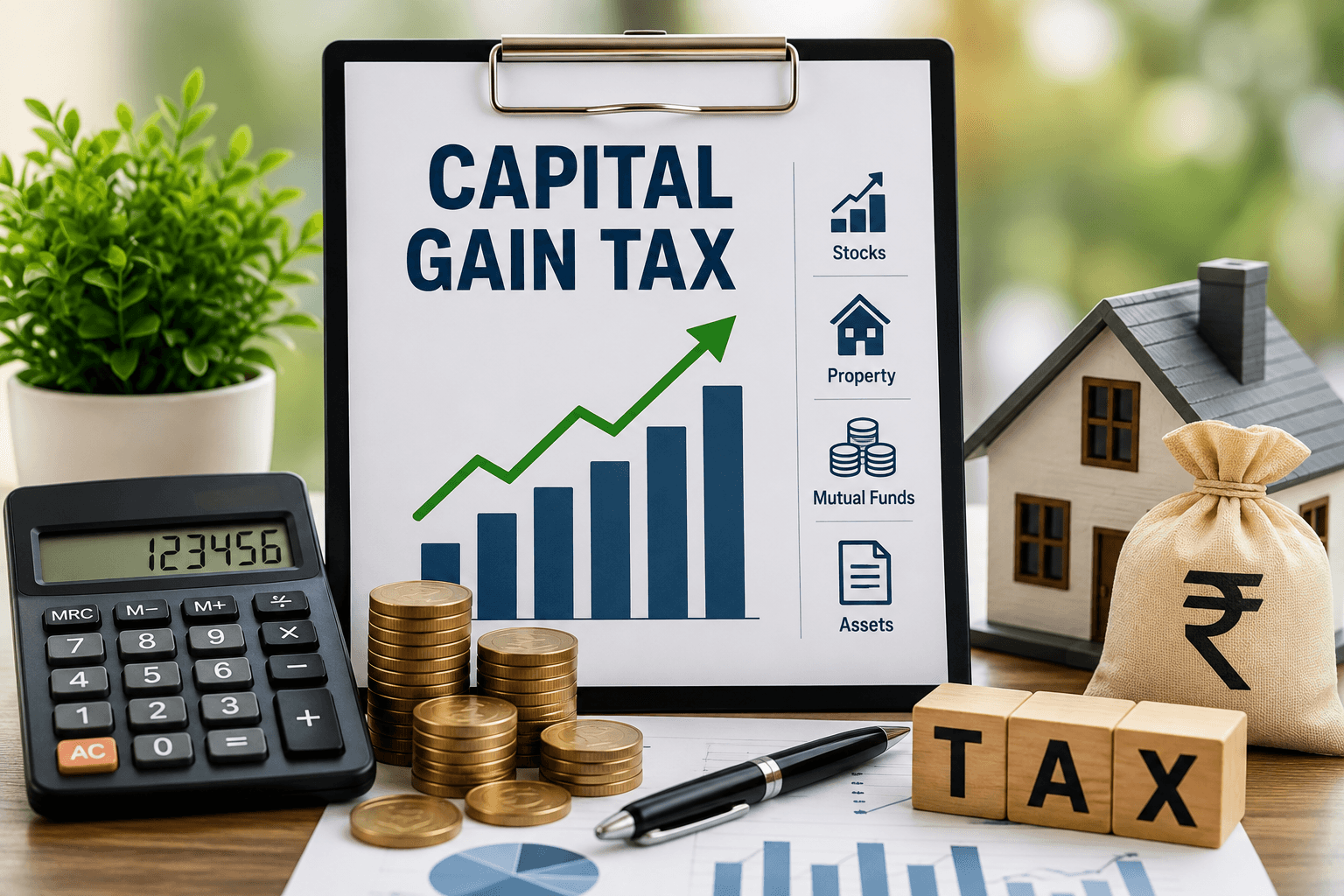
Capital gains tax applies to profits earned from transferring capital assets such as shares, mutual funds, property, gold, bonds and other investments.
Shares
Listed equity and other securities may have special rates.
Property
Land and buildings can generate taxable capital gains.
Investments
Gold, mutual funds, bonds and other assets may be taxable.
Classification
Short-Term vs Long-Term
Short-Term Capital Gain
Gain from an asset that does not meet the prescribed long-term holding period.
Long-Term Capital Gain
Gain from an asset held beyond the prescribed long-term holding period.
Broadly, listed securities generally use a 12-monththreshold, while many other assets use a 24-monththreshold. Special rules can apply to certain assets.
Calculation
How Capital Gains Are Calculated
Basic Formula
Sale Consideration−Transfer Expenses−Cost of Acquisition−Cost of Improvement
The exact calculation may differ depending on the asset and applicable tax provisions.
Current Rates
Capital Gains Tax Rates
20%
STCG
Eligible listed equity, equity-oriented mutual funds and business trust units under Section 111A.
12.5%
LTCG Equity
Eligible Section 112A gains above the ₹1.25 lakh annual threshold.
12.5%
Other LTCG
General rate for many long-term capital assets, subject to applicable exceptions.
Short-term gains not covered by a special concessional rate are generally taxed according to the taxpayer's applicable income-tax rates.
Equity Investments
₹1.25 Lakh LTCG Threshold
₹1.25 Lakh
Eligible long-term gains covered by Section 112A receive an aggregate exemption threshold of ₹1.25 lakh in a financial year, subject to applicable conditions.
Capital Losses
Set-Off & Carry Forward
Short-Term Loss
May generally be set off against both short-term and long-term capital gains.
Long-Term Loss
May generally be set off only against long-term capital gains.
Eligible unabsorbed capital losses may generally be carried forward for up to 8 assessment years, subject to conditions such as timely filing.
Tax Benefits
Capital Gains Exemptions
Section 54
Relief for eligible long-term gains from a residential house when prescribed reinvestment conditions are met.
Section 54EC
Potential exemption when eligible gains are invested in notified bonds, subject to limits and conditions.
Section 54F
Relief for eligible long-term gains from assets other than a residential house, subject to conditions.
Capital Gains Account Scheme
In certain cases, unutilised gains can be deposited within prescribed timelines to preserve exemption eligibility.
Important Update
Changes From 23 July 2024
STCG under Section 111A increased from 15% to 20%.
LTCG under Section 112A increased from 10% to 12.5%.
Section 112A exemption threshold increased from ₹1 lakh to ₹1.25 lakh.
General LTCG rate under Section 112 was rationalised to 12.5% for applicable transfers.
Indexation treatment changed for several categories of long-term assets.
Certain unlisted bonds and debentures are subject to specific tax provisions.
ITR Filing
Reporting Capital Gains
Capital gains should generally be reported under the appropriate Schedule CGin the income-tax return.
Purchase and sale agreements
Broker contract notes
Demat statements
Mutual fund statements
Property documents
Improvement expense records
Brokerage and transfer expenses
Exemption investment records
Checklist
Before Filing Capital Gains
Identify the type of capital asset.
Check the applicable holding period.
Calculate the correct sale consideration and costs.
Check the applicable STCG or LTCG rate.
Review available exemptions.
Maintain purchase and sale records.
Report gains and losses under Schedule CG.
Check surcharge and 4% Health & Education Cess where applicable.
FAQs
Capital Gains Questions
What is capital gains tax?+
It is tax on profits arising from the transfer of a capital asset such as shares, mutual funds, property, gold or bonds.
What is the difference between STCG and LTCG?+
The classification depends on the asset type and prescribed holding period. Listed securities generally use 12 months, while many other assets use 24 months.
What is the LTCG exemption for eligible equity investments?+
For eligible gains covered under Section 112A, the aggregate threshold is ₹1.25 lakh in a financial year, subject to applicable conditions.
Can capital losses be carried forward?+
Eligible capital losses may generally be carried forward for up to eight assessment years, subject to the applicable conditions.
Can I save tax by reinvesting capital gains?+
Certain exemptions may be available under Sections 54, 54EC and 54F if the prescribed conditions and timelines are satisfied.
Conclusion
Understand Your Capital Gains
Capital gains taxation depends on the asset, acquisition date, transfer date, holding period, taxpayer status and applicable exemptions. Keeping accurate investment records can make tax reporting much easier.
For property, foreign assets, ESOPs, unlisted securities or large transactions, consider professional tax advice.
Disclaimer
Capital gains taxation can vary depending on the asset, acquisition date, transfer date, holding period, taxpayer status, residential status and exemptions claimed. Tax rules may change, so verify the latest provisions before filing.
Need help with Capital Gains?
Talk to a Wealth Doctor — free advice.