

Zero-Coupon · Sovereign · Short-Term
Treasury Bills (T-Bills)
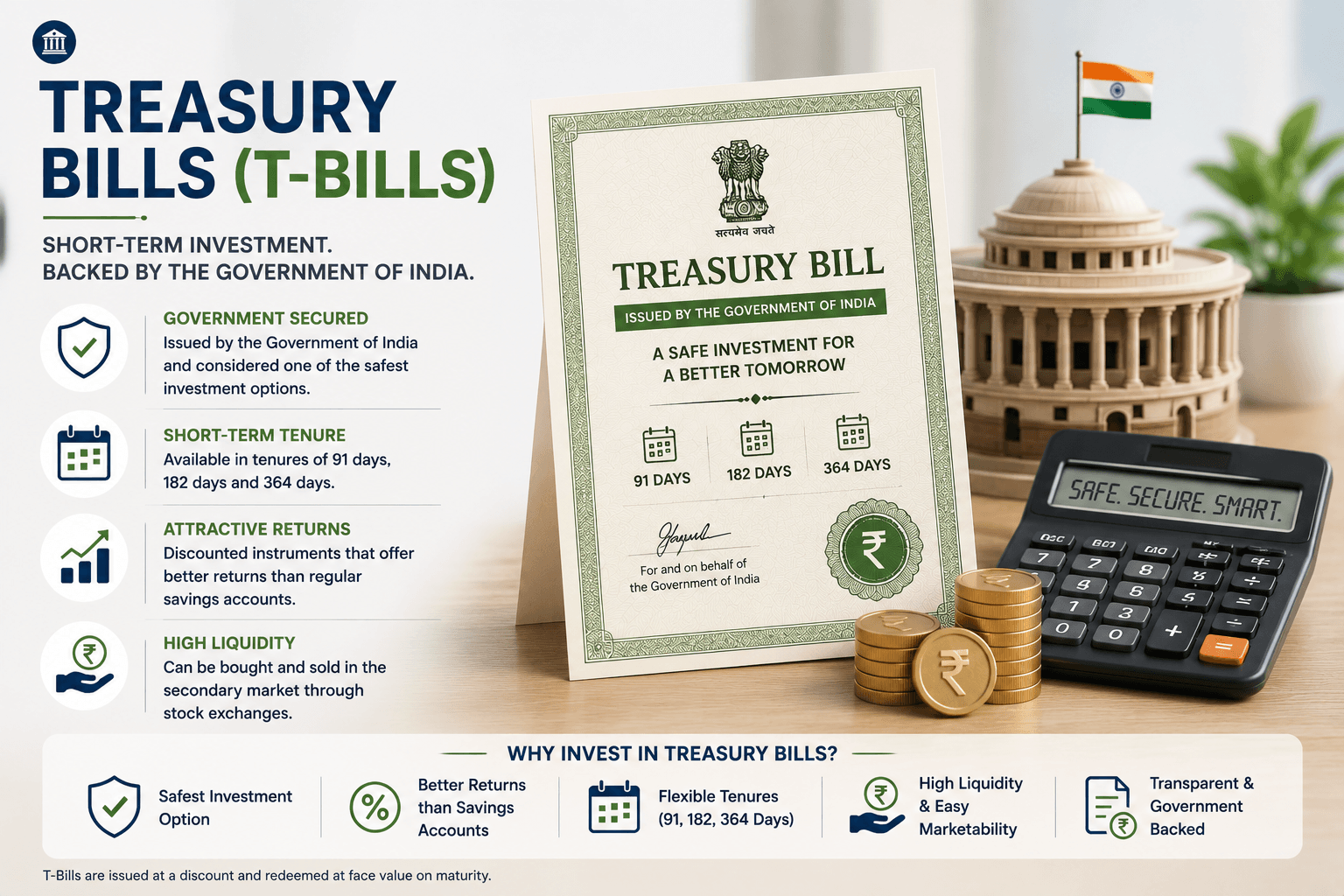
Short-term Government of India securities issued at a discount and redeemed at face value — no periodic interest, very low credit risk, and three standard maturities from 91 days to one year.
Sovereign Backed
Issued by the Government of India — among the lowest credit-risk instruments.
91 to 364 Days
Three standard maturities to match short-term financial goals.
Discount Issue
Bought below face value; return earned as the difference at maturity.
Market Liquidity
T-Bills can be traded on the secondary market before maturity.
Retail Access
Available to eligible retail investors via RBI Retail Direct from ₹10,000.
Overview
What Are Treasury Bills?
Treasury Bills are short-term debt instruments issued by the Government of India to meet its short-term funding requirements. They are zero-coupon securities — they pay no periodic interest. Instead, they are issued at a discount to face value and redeemed at face value on maturity. The difference between the purchase price and the face value is the investor's return. Yields are determined through RBI auctions and change with each auction cycle.
How the Discount Mechanism Works · Illustrative Example
You Pay
₹9,850
purchase price (below face value)
At Maturity
₹10,000
full face value repaid by GoI
Your Return
₹150
the discount — no coupons involved
* Illustrative only. Actual purchase price and yield determined by RBI auction cut-offs and prevailing market conditions.
Maturities
Three Standard T-Bill Tenures
91-Day
~5.34%
indicative yield · market-linked
Very short-term surplus parking
Closest to a liquid alternative among G-Secs
182-Day
~5.60%
indicative yield · market-linked
Medium short-term goals
Bridges the gap between 91-day and 364-day bills
364-Day
~5.74%
indicative yield · market-linked
~1 year investment horizon
Highest typical yield among the three standard maturities
Yields shown are approximate and based on recent RBI auction data. They change with every auction. Always check the latest RBI auction results at rbi.org.in before investing.
How to Invest
Access for Retail Investors
- Open a Retail Direct Gilt (RDG) account at retaildirect.rbi.org.in — free to open
- Complete KYC with Aadhaar / PAN and link a savings bank account
- Participate in primary auctions under the non-competitive bidding facility
- Minimum retail bid is ₹10,000 face value, in multiples of ₹10,000
- Alternatively, purchase through banks, primary dealers, or authorised brokers
- Indirect exposure available via money-market mutual funds or G-Sec ETFs
Markets
Primary vs Secondary
Primary Market
T-Bills are purchased at RBI auctions. Retail investors use the non-competitive bidding facility — you bid at the weighted average cut-off yield rather than competing with institutions.
Secondary Market
T-Bills can be bought or sold before maturity. The price you receive depends on prevailing yields, demand, and liquidity at the time — it may be above or below your original purchase price.
Cash Management Bills (CMBs)
The Government may also issue CMBs with maturities under 91 days to manage temporary cash-flow requirements. They share the same discount-based structure as regular T-Bills.
Benefits
Why Investors Use T-Bills
Very low credit risk
T-Bills are direct obligations of the Government of India — carrying sovereign credit backing and considered among the lowest-default-risk instruments available in the Indian market.
No coupon complexity
Zero-coupon structure means no reinvestment decisions mid-tenure. You buy, wait for maturity, and receive face value. Ideal for predictable, defined-horizon parking of funds.
Short, flexible tenures
Three maturities — 91, 182, and 364 days — let you ladder investments across multiple auctions to manage liquidity and reinvestment timing.
Accessible retail entry
A minimum of ₹10,000 face value makes T-Bills one of the more accessible Government securities for retail investors, unlike CDs which require ₹5 lakh or more.
Risks
Understand the Risks Before You Invest
Interest Rate Risk
If market rates rise after you buy, the secondary-market price of your T-Bill may fall below what you paid. Held to maturity, you receive face value regardless.
Liquidity Risk
Secondary-market liquidity for T-Bills can vary. Selling quickly before maturity is not guaranteed and the price received depends on buyers and prevailing conditions.
Reinvestment Risk
At maturity, the yields available on new T-Bills may be lower than the yield locked in on your original investment.
Inflation Risk
T-Bill returns are nominal. If inflation rises significantly, the real purchasing power of your return may be eroded.
Things to Know
Before You Invest
- Yields are market-driven and change with every RBI auction — no permanently fixed rate
- Returns are taxable; treatment depends on applicable income-tax provisions and your individual position
- Selling before maturity may result in a price below or above the purchase price depending on market conditions
- Reinvestment risk — when the T-Bill matures, prevailing yields may be lower
- T-Bills are suitable for capital preservation and short-term parking, not long-term wealth creation
- Always check the latest RBI auction schedule and cut-off yields before investing
Not sure which T-Bill tenure suits your goal?
Talk to a Wealth Doctor — free advice.