

Equity · Market Investment · Wealth Creation
Stocks / Equities
Investing in shares provides an opportunity to participate in the ownership and growth of listed companies, while carrying market risk.
Capital Growth
Potential appreciation over time.
Dividends
Income where declared by companies.
Business Ownership
Participate in company growth.
Regulated Market
SEBI-regulated securities market.
Overview
What Are Stocks or Equities?
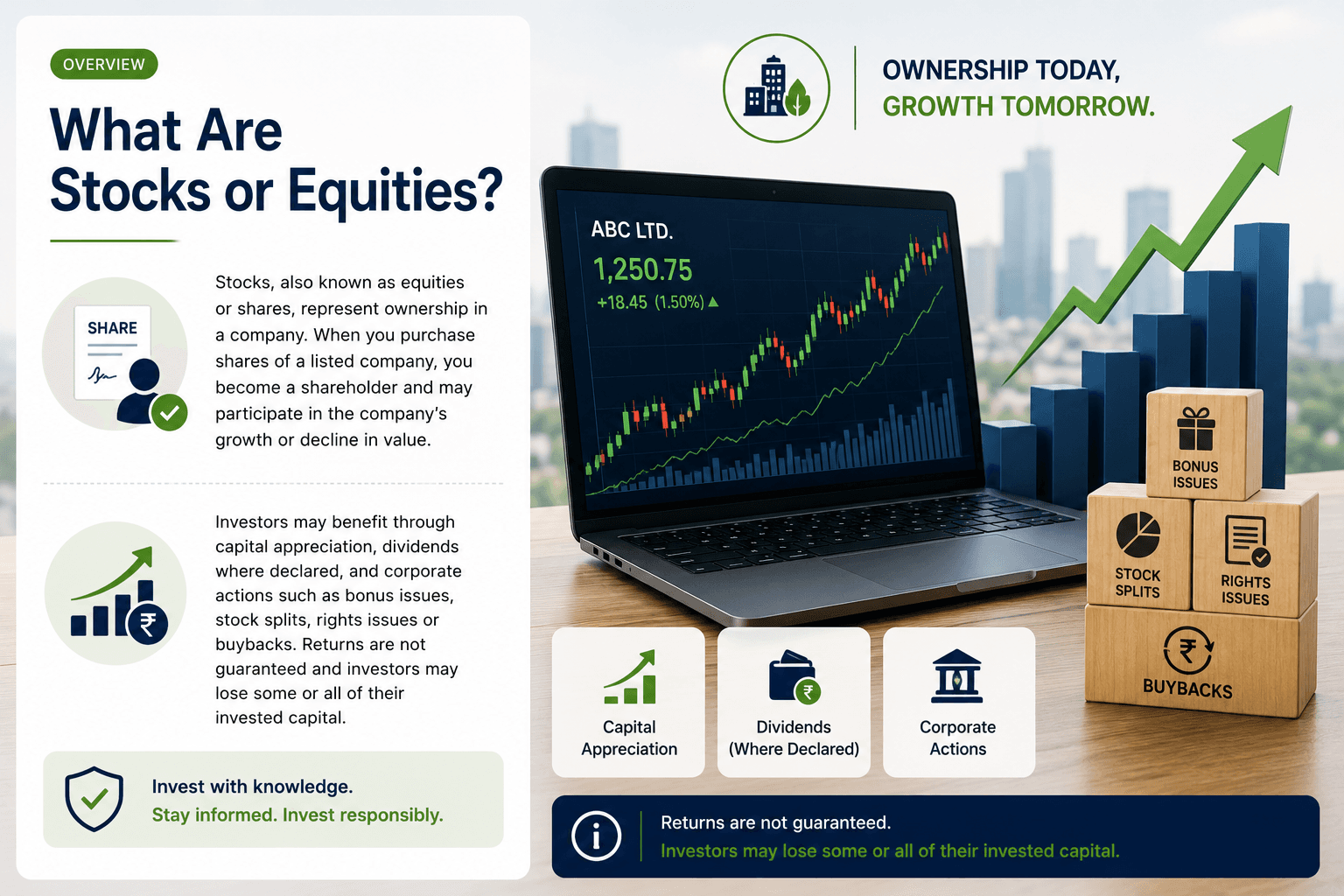
Stocks, also known as equities or shares, represent ownership in a company. When you purchase shares of a listed company, you become a shareholder and may participate in the company's growth or decline in value.
Investors may benefit through capital appreciation, dividends where declared, and corporate actions such as bonus issues, stock splits, rights issues or buybacks. Returns are not guaranteed and investors may lose some or all of their invested capital.
Why Invest
Why Invest in the Stock / Equity Market?
- Potential for long-term wealth creation through capital appreciation
- Participation in the economic performance and growth of companies
- Potential dividend income where companies declare dividends
- Liquidity for shares listed on recognised stock exchanges
- Diversification across companies, sectors and asset classes
- Participation within India's regulated securities market framework
Eligibility
Who Can Invest in the Stock / Equity Market?
- Resident Indian individuals
- Hindu Undivided Families (HUFs)
- Companies and other corporate entities
- Mutual funds and institutional investors
- NRIs and other eligible non-resident investors
Individual investors generally need PAN, KYC compliance, a bank account and demat/trading arrangements as applicable.
Key Features
How Investors Can Participate
- Direct equity through shares of listed companies
- Initial Public Offerings (IPOs) when companies offer securities to the public
- Exchange-Traded Funds (ETFs) traded on stock exchanges
- Equity mutual funds providing indirect exposure to shares
- REITs and InvITs providing exposure to real estate or infrastructure-related assets
Market Structure
Indian Stock / Equity Market
India's equity market operates through recognised exchanges and market infrastructure that facilitate trading, clearing and settlement of securities.
BSE Ltd.
National Stock Exchange of India Ltd. (NSE)
Getting Started
How to Invest in Listed Shares
KYC & Accounts
Complete KYC and arrange PAN, bank, demat and trading accounts.
Choose a Broker
Use a SEBI-registered broker or appropriate authorised intermediary.
Research & Invest
Research the company, risks and valuation before placing an order.
Market History
A Brief History of the Indian Stock Market
BSE traces its origins to 1875, when the Native Share and Stock Brokers' Association was established. India's securities market has since evolved through electronic trading, dematerialisation, online account opening and improved clearing and settlement systems.
Trading vs Investing
Difference Between Trading and Investing
Trading
Generally involves shorter-term buying and selling to potentially benefit from price movements, often with greater exposure to short-term volatility.
Investing
Generally involves holding assets for medium- to long-term goals, with focus on business fundamentals, growth and portfolio objectives.
Neither trading nor investing guarantees profits. The appropriate approach depends on knowledge, financial circumstances, objectives and risk tolerance.
Research
What to Research Before Buying a Share
- Company's business model and industry conditions
- Financial performance, profitability and cash flows
- Debt levels and financial position
- Management and corporate governance
- Valuation and expected growth
- Key business and market risks
Risk
Understand Equity Market Risk
Equity prices are subject to market fluctuations, particularly over shorter periods. There is a possibility of loss, and investors should align their investment horizon with their financial objectives and risk tolerance.
Before Investing
Things to Consider
- Understand that equity returns are not guaranteed
- Define your financial goals and investment horizon
- Consider your risk tolerance before investing
- Diversify across companies and sectors where appropriate
- Research the company's business, financials and valuation
- Avoid schemes promising assured or unusually high returns
- Deal only with SEBI-registered and authorised intermediaries
- Understand brokerage, taxes, statutory levies and other charges
- Keep trading passwords, OTPs and account credentials secure
- Consider professional advice from a SEBI-registered Investment Adviser where needed
Costs
Understand Investment and Trading Charges
Before investing or trading, understand applicable brokerage, transaction charges, statutory levies, account maintenance charges and other costs. These can affect the overall investment outcome.
Security
Keep Your Investment Accounts Secure
Do not share trading passwords, OTPs or other confidential account credentials. Regularly review account statements, transaction alerts and demat holdings, and keep your account information updated.
Documentation
Documents & Account Requirements
- PAN and KYC information
- Identity and address proof, where required
- Bank account details
- Demat account details
- Trading account information
- Nominee details, where applicable
- Other documents required by the broker or intermediary
Professional Guidance
Consider Professional Investment Advice
If personalised investment advice is required, consider consulting an appropriately registered investment professional. SEBI investor guidance recommends considering investment objectives and risk appetite and, where necessary, consulting a SEBI-registered Investment Adviser.
Conclusion
A Disciplined Approach to Equity Investing
Stocks and equities can be an important component of a long-term investment portfolio and provide an opportunity to participate in the growth of listed companies.
However, equity investing involves market risk and returns, including dividends, are never guaranteed. Clear goals, suitable risk tolerance, diversification, research and long-term planning can help investors make more informed decisions.
Need help understanding equity investments?
Talk to a Wealth Doctor — free advice.