

Real Estate · Income Potential · Listed Investment
Real Estate Investment Trusts (REITs)
Real Estate Investment Trusts (REITs) are fixed-income instruments through which investors lend money to an issuer for a specified period in return for interest and repayment of principal according to the instrument's terms.
Real Estate Exposure
Access income-generating property without directly owning physical real estate.
Potential Income
Listed REITs may distribute cash generated by underlying properties.
Liquidity
Listed units can generally be bought and sold on recognised stock exchanges.
Professional Management
Properties and portfolios are managed within the applicable framework.
Overview
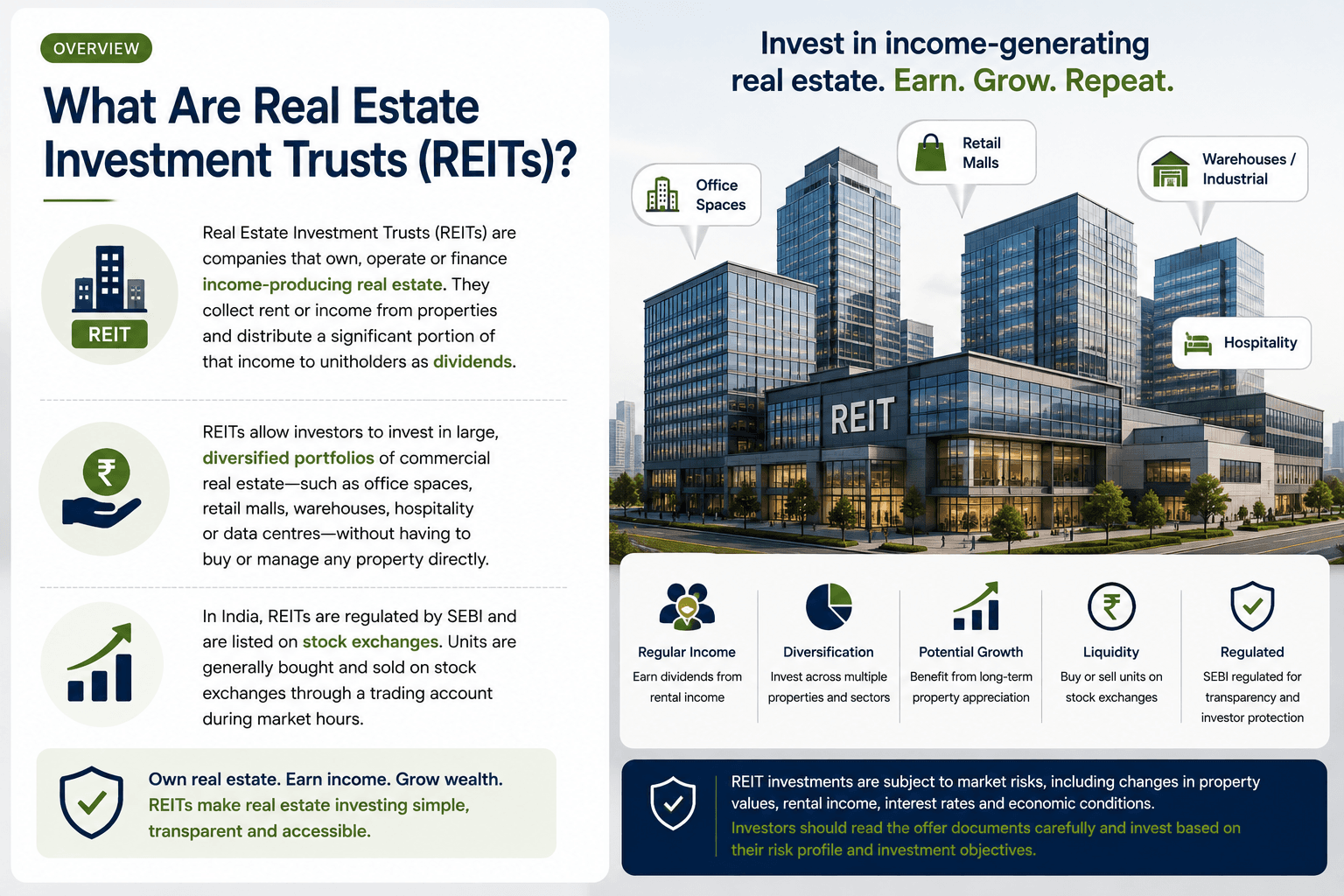
What Are Real Estate Investment Trusts (REITs)?
Real Estate Investment Trusts (REITs) are fixed-income investment instruments through which an investor lends money to an issuer for a specified period. The issuer may be the Government of India, a State Government, a corporation, a financial institution, or another eligible entity. In return, the issuer generally agrees to pay interest and repay the principal according to the terms of the instrument.
In India, ETFs operate within the mutual fund and securities market framework. Units are generally bought and sold on stock exchanges through a trading account during market hours.
Why Invest
Why Invest in Real Estate Investment Trusts (REITs)?
- Potential Income through a basket of securities or an underlying asset
- Exchange trading during market hours at prevailing market prices
- Passive market exposure through an index or underlying asset
- Portfolio transparency and disclosure of the underlying benchmark
- Potentially lower costs for passive strategies, subject to TER and transaction costs
- Access to equity, debt, gold, silver, international and sectoral strategies
Eligibility
Who Can Invest in Real Estate Investment Trusts (REITs)?
- Eligible investors with a trading and demat account
- Resident individuals and other eligible investors meeting KYC requirements
- NRIs and other eligible investors, where permitted
- Investors using a SEBI-registered broker or eligible intermediary
- PAN, bank account, KYC and applicable demat/trading requirements generally apply
The exact eligibility and account requirements depend on the ETF and intermediary selected.
Types of Real Estate Investment Trusts (REITs)
How Investors Can Access Real Estate Investment Trusts (REITs)
- Equity REITs: primarily own or invest in income-generating real estate assets and earn income from rentals and related operations
- Mortgage REITs: primarily provide financing for real estate or invest in real estate debt and mortgage-related instruments
- Hybrid REITs: may combine characteristics of equity and mortgage-focused real estate investments
- Corporate Real Estate Investment Trusts (REITs) and Non-Convertible Debentures (NCDs)
- Listed REIT units provide market-based exposure to the underlying real estate portfolio.
How Do Real Estate Investment Trusts (REITs) Work?
Indian Stock / Equity Market
A REIT pools capital from investors and invests in eligible income-generating real estate assets through permitted structures. Investors purchase listed units and may receive periodic distributions while the market value of units can rise or fall.
Open Trading & Demat Accounts
Research the REIT
Getting Started
How to Invest in Listed Shares
Choose the Route
Use Open Trading & Demat Accounts, a broker, a regulated bond platform or another permitted channel.
Review the Portfolio
Review property types, locations, occupancy, tenants, lease arrangements, debt and distribution history.
Risks & Invest
Risks the company, risks and valuation before placing an order.
Market History
Current Ways to Invest in Real Estate Investment Trusts (REITs) in India
Retail investors may access eligible government securities through Open Trading & Demat Accounts, certain listed bonds through stock brokers and demat accounts, eligible debt securities through SEBI-regulated Online Bond Platform Providers, and debt mutual funds or bond ETFs.
Potential Real Estate Exposure vs Potential Income
Benefits of Potential Income in Real Estate Investment Trusts (REITs)
Potential Real Estate Exposure
Potential Income across a basket of securities or an asset class
Potential Income
Real Estate Investment Trusts (REITs) can help reduce over-concentration in a portfolio consisting only of equity investments.
Passive exposure to an index or underlying asset
Risks
What to Risks Before Buying a Share
- Market risk: REIT unit prices can rise or fall with market conditions and investor sentiment
- Real estate market risk: property values, rental demand and occupancy can affect performance
- Interest-rate risk: higher rates can increase borrowing costs and affect valuations
- Tenant and occupancy risk: tenant loss or lower occupancy can reduce cash flows
- Concentration risk: exposure to a city, sector, property type or major tenant can increase risk
- Liquidity risk: trading volumes may affect the ability to buy or sell at the desired price
Risk
Understand REIT Investment Risk
Real Estate Investment Trusts (REITs) are not completely risk-free. Interest-rate, credit, liquidity, reinvestment, inflation and market-price risks can affect the outcome, especially when a bond is sold before maturity.
Before Potential Income
Things to Consider Before Investing in Real Estate Investment Trusts (REITs)
- Ensure the REIT fits your financial goals and desired income or growth objectives
- Assess your risk tolerance because REIT prices can fluctuate
- Review the quality, location and type of the property portfolio
- Review occupancy, tenant profile and lease structure
- Risks the company's business, financials and valuation
- Review past distributions without assuming future income
- Consider management fees, expenses and other costs
- Consider liquidity and the market price of listed units
- Review official offer documents, financial results and investor disclosures
- Consider qualified financial or tax advice where appropriate
Costs
Understand Investment and Potential Real Estate Exposure Charges
Tax treatment can depend on the nature of distributions, investor status and applicable tax laws. Investors should also consider management fees and other costs.
Security
Review REIT Liquidity and Market Price
Listed REIT units can generally be traded on recognised exchanges, but trading volume and market conditions can affect price and execution.
Documentation
Key REIT Details to Review
- Property portfolio and investment strategy
- Occupancy and tenant profile
- Lease structure and rental income concentration
- Debt and leverage
- Potential Real Estate Exposure account information
- Expenses and management costs
- Financial statements, offer documents and investor disclosures
Professional Guidance
Consider Professional Guidance
If you need personalised investment or tax guidance, consider consulting a SEBI-registered investment adviser or qualified financial professional where appropriate.
Conclusion
A Disciplined Approach to Equity Potential Income
Real Estate Investment Trusts (REITs) can be a useful component of a diversified investment portfolio, particularly for investors seeking fixed-income opportunities and different levels of risk and maturity.
However, REITs involve market, real estate, interest-rate, tenant, occupancy, concentration, liquidity and distribution risks. Investors should evaluate the portfolio, debt, cash flows, market price, taxation and suitability before investing.
Need help understanding REITs?
Talk to a Wealth Doctor — free advice.