

Fixed Income · Sovereign Backed · RBI Retail Direct
Government Savings Bonds
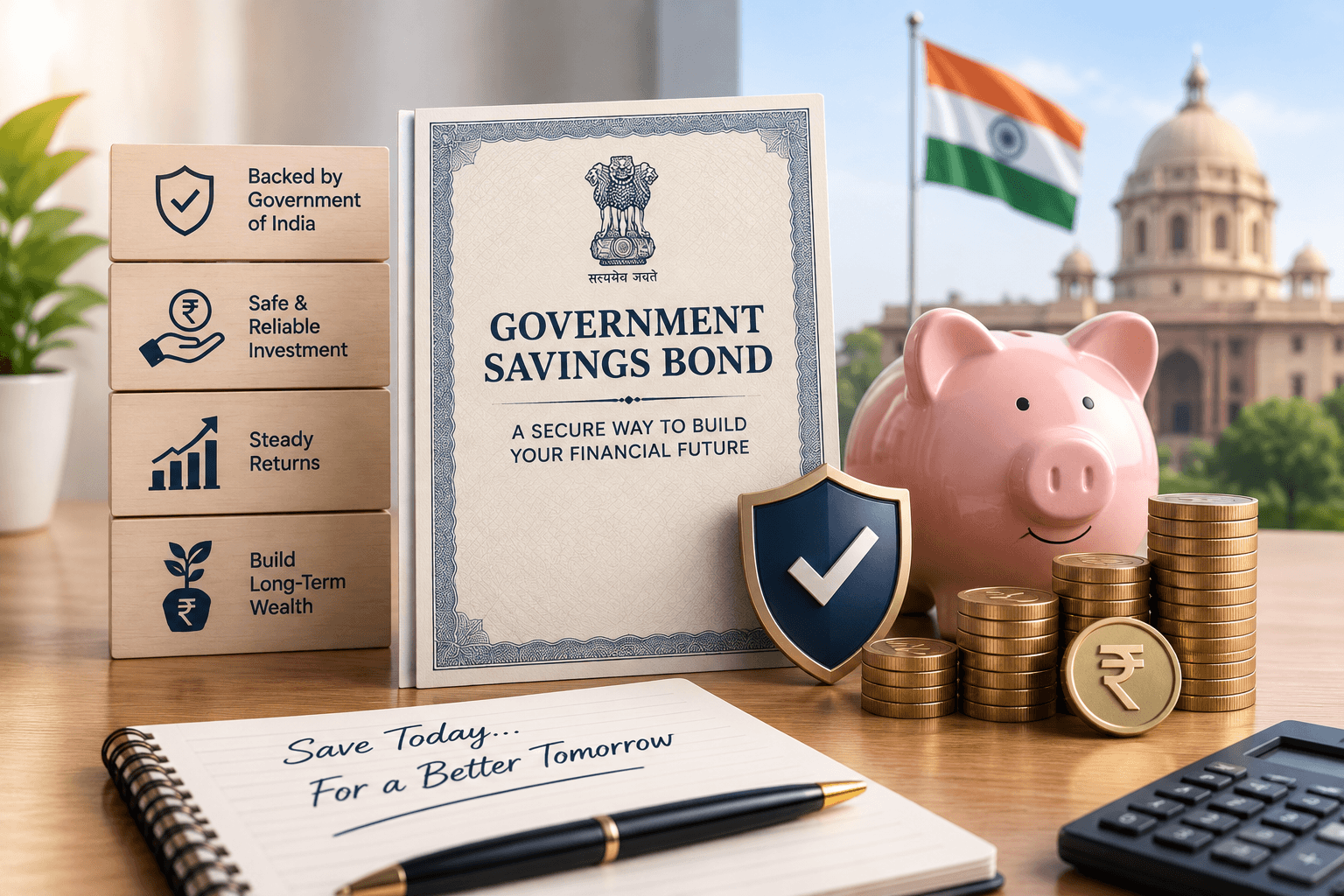
Fixed-income securities issued or backed by the Government of India — from 91-day Treasury Bills to 7-year floating-rate bonds — now accessible directly to retail investors via RBI Retail Direct.
Sovereign Backed
Issued or backed by the Government of India — very low credit risk.
Predictable Income
Coupon-paying bonds provide periodic interest at defined intervals.
Multiple Tenures
91-day T-Bills to long-duration G-Secs — match your time horizon.
Floating Option
FRSB 2020(T) rate resets every 6 months — linked to NSC + 35 bps.
Retail Direct
Eligible individuals can invest directly via RBI Retail Direct.
Overview
What Are Government Savings Bonds?
Government Savings Bonds are fixed-income securities issued or backed by the Government of India or its agencies. When you invest, you are effectively lending money to the issuer in return for interest — or another predetermined return — and repayment at maturity. The term covers a range of instruments including G-Secs, Treasury Bills, State Development Loans, and the Floating Rate Savings Bonds 2020 (Taxable).
Types of Government Securities at a Glance
| Instrument | Tenure | Return Type | Tradeable |
|---|---|---|---|
G-Secs Government of India Dated Securities | Medium to long-term | Fixed or floating coupon | Yes |
T-Bills Treasury Bills | 91 / 182 / 364 days | Discount to face value | Yes |
SDLs State Development Loans | Varies by state | Coupon-bearing | Yes |
FRSB 2020 (T) Floating Rate Savings Bonds | 7 years | NSC rate + 35 bps, reset 6-monthly | No |
* Rates, tenures, and auction conditions are reviewed periodically by RBI and the Government.
Mechanism
How They Work
- Coupon bonds — Pay interest periodically; return principal at maturity.
- Treasury Bills — No coupon — issued at a discount, redeemed at face value.
- Floating-rate bonds — Interest rate changes per the scheme formula every 6 months.
- Marketable securities — Can be bought or sold before maturity at prevailing market prices.
- Non-tradeable bonds — Must generally be held to maturity; transfer restrictions apply.
How to Invest
Getting Started
- Open a Retail Direct Gilt (RDG) account at retaildirect.rbi.org.in — free to open and maintain
- Complete KYC with Aadhaar / PAN and link a savings bank account
- Participate in primary auctions for T-Bills, G-Secs, or SDLs during announced auction windows
- Access secondary-market transactions for eligible marketable securities via the RDG platform
- Alternatively, purchase through eligible banks, brokers, or depository participants
Why Consider
Reasons Investors Choose Government Securities
Low credit risk
Government of India securities carry very low credit risk in the domestic market due to sovereign backing. This does not, however, eliminate market price risk if you sell a bond before maturity.
Portfolio diversification
Adding fixed-income government securities alongside equities, mutual funds, or corporate bonds can reduce overall portfolio volatility and provide a predictable income stream.
Range of tenures
From 91-day T-Bills to long-duration G-Secs, investors can match the maturity to their financial goals and interest-rate outlook.
Direct retail access
The RBI Retail Direct Scheme allows eligible individuals to open a Retail Direct Gilt account and participate in primary auctions and secondary-market transactions — without going through a broker.
Comparison
Government Securities vs Bank Fixed Deposits
| Feature | Government Securities | Bank Fixed Deposits |
|---|---|---|
| Issuer | Central / State Government | Bank |
| Credit Risk | Generally very low (sovereign) | Depends on bank & deposit protection |
| Returns | Fixed, floating, or market-linked | Usually fixed for chosen tenure |
| Price Fluctuation | Yes, for marketable securities | Generally no, when held to maturity |
| Liquidity | Depends on instrument & market | Depends on tenure & withdrawal terms |
| Interest-Rate Risk | Significant for long-duration bonds | Limited when held to maturity |
| Tax Treatment | Per prevailing tax laws on security type | Per applicable tax laws |
Risks
Understand the Risks Before You Invest
Interest Rate Risk
Bond prices move inversely to rates. If rates rise, the market price of an existing fixed-rate bond falls. Selling before maturity can result in a capital loss.
Reinvestment Risk
When interest or principal is received, future rates may be lower than the rate at the time of original investment.
Inflation Risk
A fixed nominal return may lose purchasing power if inflation rises significantly over the investment period.
Liquidity Risk
Non-tradeable bonds have specific lock-in or premature-redemption conditions. Even marketable securities can have thin secondary markets for certain instruments.
Things to Know
Before You Invest
- Marketable bonds sold before maturity may fetch less than the purchase price if interest rates have risen
- Interest earned is generally taxable as per your income-tax slab; check the latest provisions before investing
- Non-tradeable instruments like FRSB 2020 (T) cannot be sold — check lock-in and premature-redemption rules
- T-Bills do not pay periodic coupons — return is realised only at maturity via the discount mechanism
- SDL yields and market characteristics differ from Central Government securities
- Minimum investment amounts apply per RBI auction rules — verify the latest amounts before placing an order
- Future interest-rate changes may affect the income from FRSB 2020 (T) at each six-month reset
Access
How to Buy Government Securities
RBI Retail Direct
Open a free Retail Direct Gilt account at retaildirect.rbi.org.in and participate in primary auctions and secondary-market transactions directly.
RBI Retail Direct →Banks & Brokers
Purchase eligible Government securities through authorised banks, registered brokers, or depository participants — depending on the instrument.
Debt Mutual Funds / ETFs
Investors who prefer a pooled vehicle can consider debt mutual funds or G-Sec ETFs that invest in Government securities.
Not sure which instrument suits your goal?
Talk to a Wealth Doctor — free advice.