

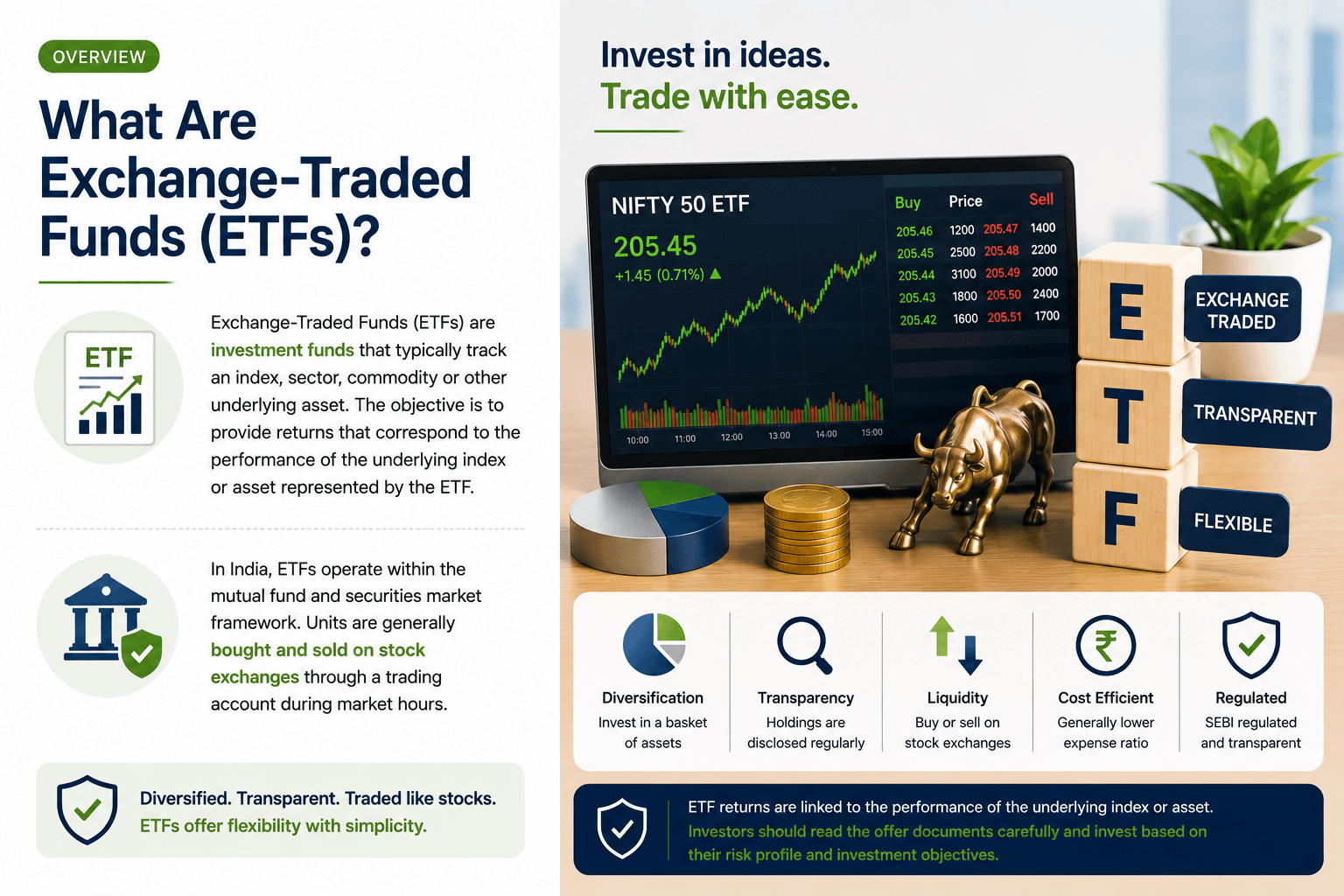
Market Traded · Diversified Exposure · Flexible Investing
Exchange-Traded Funds (ETFs)
Exchange-Traded Funds (ETFs) are fixed-income instruments through which investors lend money to an issuer for a specified period in return for interest and repayment of principal according to the instrument's terms.
Exchange Trading
Bought and sold on stock exchanges during market hours.
Diversification
One ETF can provide exposure to a basket of securities or an asset class.
Passive Exposure
Many ETFs aim to track an index or underlying asset.
Wide Range of Choices
Equity, debt, gold, silver, international and thematic ETFs.
Overview
What Are Exchange-Traded Funds (ETFs)?
Exchange-Traded Funds (ETFs) are fixed-income investment instruments through which an investor lends money to an issuer for a specified period. The issuer may be the Government of India, a State Government, a corporation, a financial institution, or another eligible entity. In return, the issuer generally agrees to pay interest and repay the principal according to the terms of the instrument.
In India, ETFs operate within the mutual fund and securities market framework. Units are generally bought and sold on stock exchanges through a trading account during market hours.
Why Invest
Why Invest in Exchange-Traded Funds (ETFs)?
- Diversification through a basket of securities or an underlying asset
- Exchange trading during market hours at prevailing market prices
- Passive market exposure through an index or underlying asset
- Portfolio transparency and disclosure of the underlying benchmark
- Potentially lower costs for passive strategies, subject to TER and transaction costs
- Access to equity, debt, gold, silver, international and sectoral strategies
Eligibility
Who Can Invest in Exchange-Traded Funds (ETFs)?
- Eligible investors with a trading and demat account
- Resident individuals and other eligible investors meeting KYC requirements
- NRIs and other eligible investors, where permitted
- Investors using a SEBI-registered broker or eligible intermediary
- PAN, bank account, KYC and applicable demat/trading requirements generally apply
The exact eligibility and account requirements depend on the ETF and intermediary selected.
Types of Exchange-Traded Funds (ETFs)
How Investors Can Access Exchange-Traded Funds (ETFs)
- Equity ETFs: track broad-market, large-cap, mid-cap, sectoral or thematic indices
- Debt and Bond ETFs: provide exposure to government securities or corporate bonds
- Gold ETFs: provide market-linked exposure to gold without physical storage
- Corporate Exchange-Traded Funds (ETFs) and Non-Convertible Debentures (NCDs)
- International ETFs: provide exposure to overseas markets or international indices
How Do Exchange-Traded Funds (ETFs) Work?
Indian Stock / Equity Market
An ETF generally aims to provide returns that closely correspond to its underlying benchmark or asset, subject to tracking error, expenses and other factors. Its NAV and exchange-traded market price may differ.
Open a Demat & Trading Account
Complete KYC Requirements
Getting Started
How to Invest in Listed Shares
Choose the Route
Use Open a Demat & Trading Account, a broker, a regulated bond platform or another permitted channel.
Select the ETF
Review the ETF's benchmark, portfolio, Riskometer, expense ratio and liquidity.
Risks & Invest
Risks the company, risks and valuation before placing an order.
Market History
Current Ways to Invest in Exchange-Traded Funds (ETFs) in India
Retail investors may access eligible government securities through Open a Demat & Trading Account, certain listed bonds through stock brokers and demat accounts, eligible debt securities through SEBI-regulated Online Bond Platform Providers, and debt mutual funds or bond ETFs.
Potential Exchange Trading vs Diversification
Benefits of Diversification in Exchange-Traded Funds (ETFs)
Potential Exchange Trading
Diversification across a basket of securities or an asset class
Diversification
Exchange-Traded Funds (ETFs) can help reduce over-concentration in a portfolio consisting only of equity investments.
Passive exposure to an index or underlying asset
Risks
What to Risks Before Buying a Share
- Market risk: ETF values can rise or fall with the underlying securities or asset
- Tracking error: an ETF may not perfectly replicate its benchmark
- Liquidity risk: low trading volumes can make execution more difficult
- Premium or discount risk: market price can differ from NAV
- Concentration risk: sectoral and thematic ETFs can be narrowly focused
- International and currency risk can affect overseas ETFs
Risk
Understand ETF Risk
Exchange-Traded Funds (ETFs) are not completely risk-free. Interest-rate, credit, liquidity, reinvestment, inflation and market-price risks can affect the outcome, especially when a bond is sold before maturity.
Before Diversification
Things to Consider Before Investing in Exchange-Traded Funds (ETFs)
- Ensure the ETF underlying index or asset matches your financial goal
- Review the current Riskometer and understand the underlying benchmark
- Compare tracking error and tracking difference
- Check trading volume and bid-ask spread
- Risks the company's business, financials and valuation
- Compare TER and transaction costs
- Review AUM, liquidity and portfolio quality
- Understand applicable taxation before investing or redeeming
- Use regulated intermediaries and verify registration where applicable
- Consider qualified financial or tax advice where appropriate
Costs
Understand Investment and Potential Exchange Trading Charges
ETF investors should consider TER, brokerage, exchange and transaction charges, taxes and the bid-ask spread. Tax treatment depends on the ETF structure, holding period and prevailing tax laws.
Security
Review ETF Liquidity and Pricing
Check trading volume, bid-ask spread and whether the ETF trades at a significant premium or discount to NAV.
Documentation
Key ETF Details to Review
- Underlying benchmark or asset
- Riskometer and portfolio
- Tracking error and tracking difference
- Liquidity and trading volume
- Potential Exchange Trading account information
- Total Expense Ratio and transaction costs
- Scheme Information Document, factsheet and official disclosures
Professional Guidance
Consider Professional Guidance
If you need personalised investment or tax guidance, consider consulting a SEBI-registered investment adviser or qualified financial professional where appropriate.
Conclusion
A Disciplined Approach to Equity Diversification
Exchange-Traded Funds (ETFs) can be a useful component of a diversified investment portfolio, particularly for investors seeking fixed-income opportunities and different levels of risk and maturity.
However, ETFs remain market-linked investments and can carry market, tracking, liquidity, concentration, commodity, interest-rate, credit and currency risks. Investors should evaluate the benchmark, liquidity, costs and suitability before investing.
Need help understanding ETFs?
Talk to a Wealth Doctor — free advice.