

Money Market · Short-Term · RBI Regulated
Certificate of Deposit (CD)
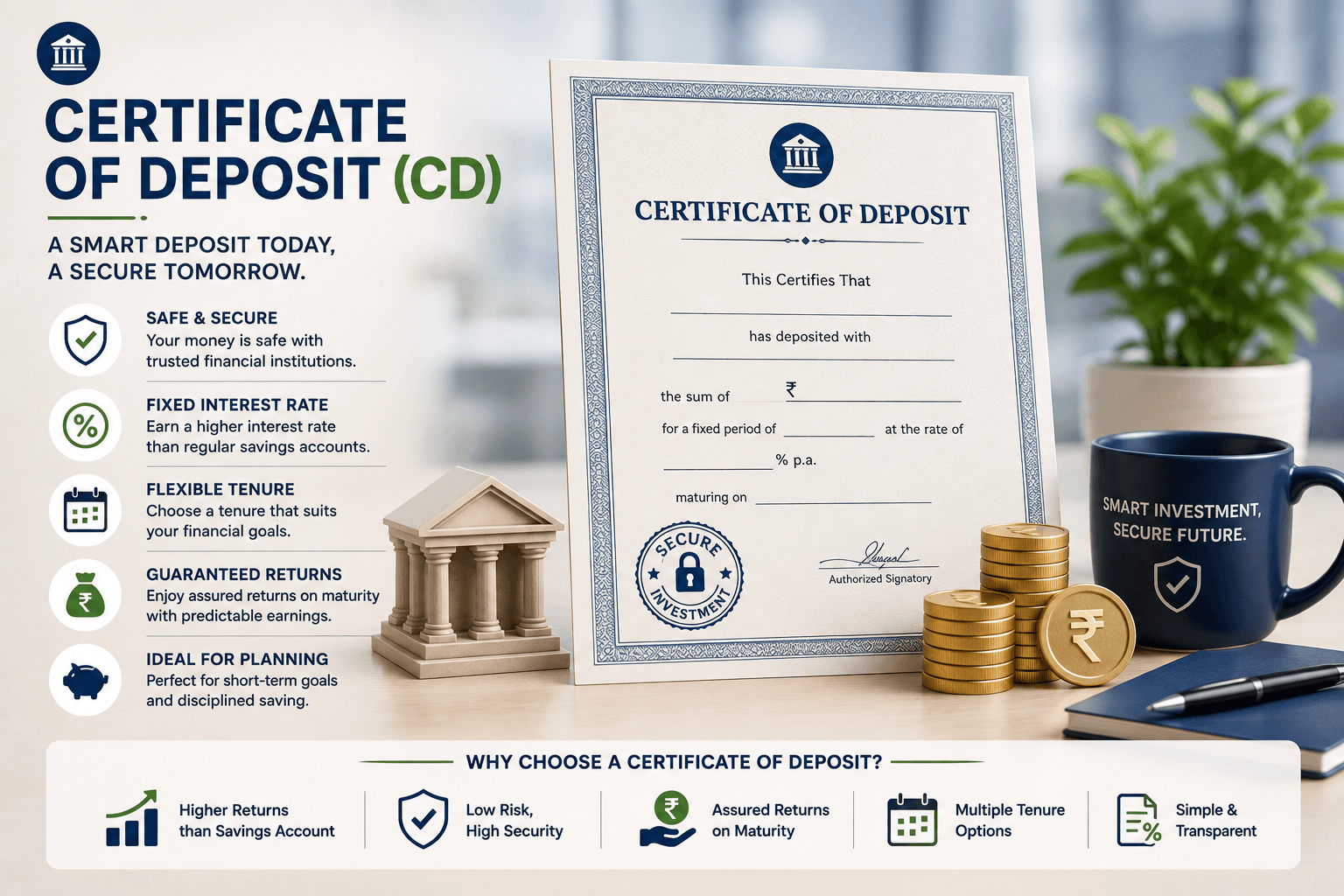
A negotiable, RBI-regulated money-market instrument issued by eligible banks — offering defined short-term returns with potential transferability, distinct from a regular fixed deposit.
RBI Regulated
Issued under RBI Certificate of Deposit Directions, 2021.
7 Days – 1 Year
Short-term tenures designed for money-market investment horizons.
Demat Form
Held in dematerialised form via a SEBI-registered depository.
Transferable
May be tradable or transferable, subject to market conditions and regulations.
Defined Returns
Return structure and maturity terms are set at the time of issuance.
Overview
What Is a Certificate of Deposit?
A Certificate of Deposit (CD) is a negotiable money-market instrument issued by eligible banks and financial institutions to raise short-term funds. Unlike a retail Fixed Deposit, a CD is a tradable instrument held in dematerialised form through a SEBI-registered depository, and requires a minimum investment of ₹5 lakh. In India, CDs are governed by the Reserve Bank of India under the Certificate of Deposit Directions, 2021.
Certificate of Deposit vs Fixed Deposit
| Feature | Certificate of Deposit | Fixed Deposit |
|---|---|---|
| Nature | Negotiable money-market instrument | Bank deposit product |
| Minimum Investment | ₹5 lakh (multiples of ₹5L) | Depends on the bank |
| Form | Dematerialised (demat) | Bank deposit record |
| Transferability | May be tradable/transferable | Generally not traded |
| Maturity | 7 days to 1 year | Flexible, bank-specific |
| Deposit Insurance | Not covered by DICGC | Up to ₹5L per depositor |
| Early Exit | Subject to market & instrument terms | Premature withdrawal with penalty |
* Per RBI Certificate of Deposit Directions, 2021. Terms subject to change.
Mechanism
How CDs Work
- Issuance — Funds are placed with an eligible bank or financial institution for a specified maturity period.
- Return structure — May be issued at a discount to face value, or with a defined coupon — terms are set at issuance.
- Demat holding — Held electronically through a SEBI-registered depository; no physical certificate.
- At maturity — Investor receives the redemption amount according to the CD terms — no rollover unless a new CD is purchased.
- Before maturity — May be sold or transferred in the secondary market, subject to availability of buyers and prevailing rates.
Types
How CDs May Differ
- By issuer — Scheduled commercial banks or eligible financial institutions under RBI directions.
- By maturity — Short-term instruments ranging from 7 days up to 1 year.
- By return — Discount-based (no coupon; return from price difference) or coupon-bearing.
- By tradability — Some CDs may have more active secondary markets than others depending on issuer and tenure.
Why Consider CDs
Potential Benefits for the Right Investor
Defined short-term returns
The return structure and maturity terms are set at issuance, giving investors clarity on what they will receive if held to maturity. This makes CDs useful for parking large sums with a short, known horizon.
Potential transferability
Unlike a conventional FD, a CD may be sold or transferred before maturity, providing a degree of flexibility for investors who may need to exit early — subject to market availability.
Regulated framework
CDs in India are issued under RBI regulations, providing an institutional framework around issuance, form, and minimum denomination that does not exist for informal lending alternatives.
Portfolio diversification
For investors with large short-term surpluses, CDs can offer money-market exposure alongside longer-duration bonds, equities, or mutual funds.
Important — Deposit Insurance
CDs Are Not Covered by DICGC
DICGC deposit insurance — which covers eligible bank deposits such as savings, fixed, current and recurring deposits up to ₹5 lakh per depositor per bank — does not extend to Certificates of Deposit or other money-market instruments. Investors should evaluate CDs based on the issuer's own creditworthiness and the instrument's regulatory terms, not on the assumption of deposit protection.
Risks
Understand the Risks Before You Invest
Interest Rate Risk
Changes in market interest rates may affect the market value of a CD before maturity. Selling in a rising-rate environment may mean receiving less than face value.
Liquidity Risk
Selling a CD before maturity depends on finding a buyer at an acceptable price. Market depth for CDs can vary significantly.
Issuer Risk
Consider the financial strength of the issuing bank or financial institution. Unlike FDs, CDs are not covered by DICGC deposit insurance.
Reinvestment Risk
When the CD matures, prevailing interest rates may be lower than the rate at the time of the original investment.
Things to Know
Before You Invest
- Minimum investment of ₹5 lakh — not a retail deposit product
- Match the maturity period to your liquidity needs before committing
- Evaluate the financial strength and creditworthiness of the issuing institution
- Understand whether the CD is issued at a discount or carries a coupon structure
- Check transferability conditions — liquidity before maturity depends on the secondary market
- Review the applicable tax treatment under current income-tax laws for your circumstances
- CDs do not receive DICGC deposit insurance coverage like a regular bank FD
Suitability
Is a CD Right for You?
More suitable for
- Investors with a short-term surplus of ₹5 lakh or more
- Those who understand money-market instruments and demat holdings
- Investors comfortable evaluating issuer creditworthiness
- Portfolio managers seeking short-duration fixed-income exposure
Less suitable for
- Retail investors seeking small-ticket, simple fixed-income products
- Those who need guaranteed liquidity before maturity
- Investors unfamiliar with demat accounts or secondary markets
- Anyone relying on DICGC deposit insurance for protection
Not sure if a CD fits your short-term needs?
Talk to a Wealth Doctor — free advice.