

Fixed Income · Debt Investment · Portfolio Diversification
Bonds
Bonds are fixed-income instruments through which investors lend money to an issuer for a specified period in return for interest and repayment of principal according to the instrument's terms.
Regular Income
Potential coupon or interest payments.
Diversification
Can complement equity investments.
Defined Maturity
Many bonds have a stated maturity date.
Risk Assessment
Credit, interest-rate and liquidity risks apply.
Overview
What Are Bonds?
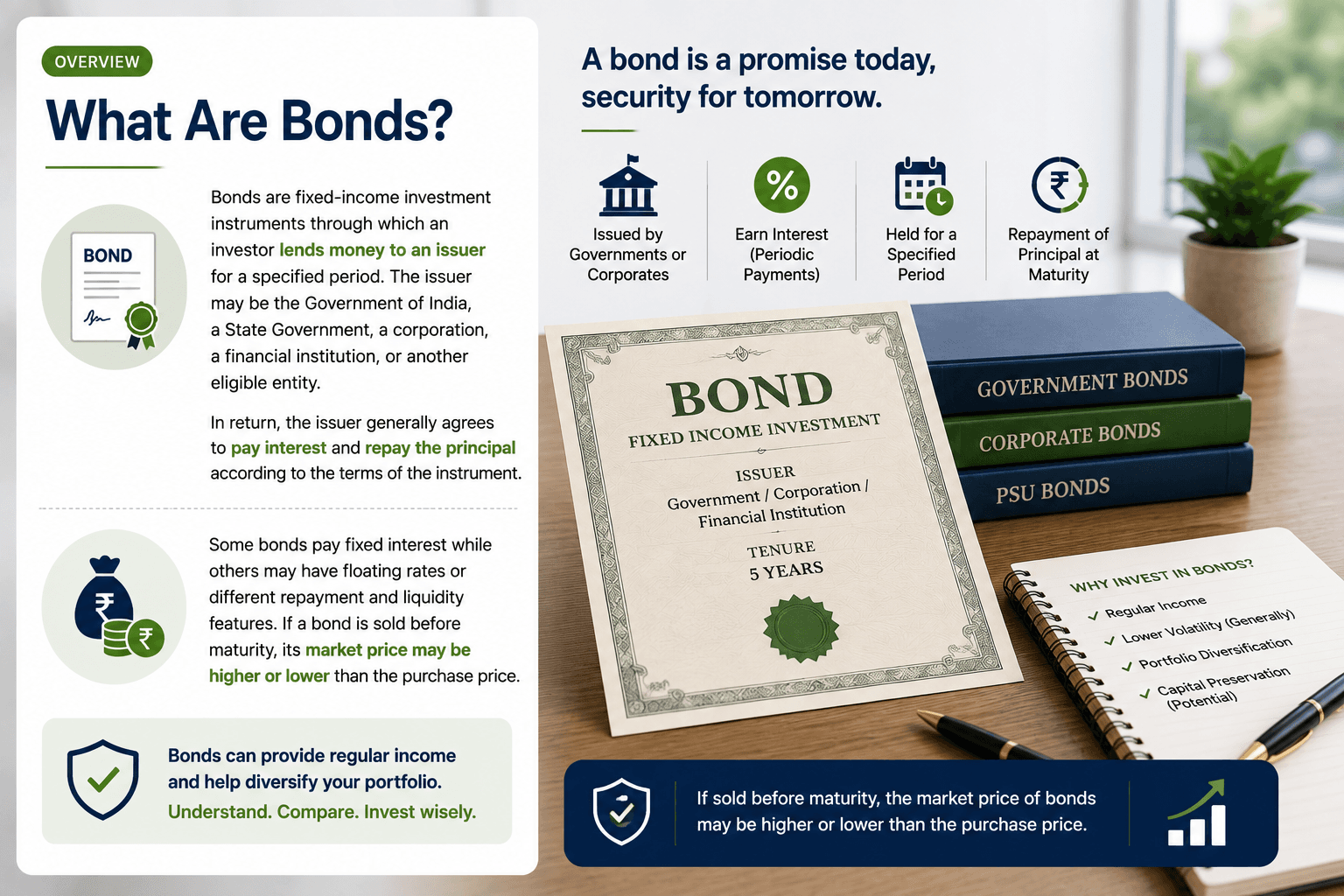
Bonds are fixed-income investment instruments through which an investor lends money to an issuer for a specified period. The issuer may be the Government of India, a State Government, a corporation, a financial institution, or another eligible entity. In return, the issuer generally agrees to pay interest and repay the principal according to the terms of the instrument.
Some bonds pay fixed interest while others may have floating rates or different repayment and liquidity features. If a bond is sold before maturity, its market price may be higher or lower than the purchase price.
Why Invest
Why Invest in Bonds?
- Potential regular income through coupon or interest payments
- Portfolio diversification alongside equities and other investments
- Potential capital preservation through high-quality fixed-income securities, although market values can fluctuate
- Different maturity options to match financial goals
- Growing retail access through RBI Retail Direct and regulated market platforms
- Choice among government securities and different categories of debt instruments
Eligibility
Who Can Invest in Bonds?
- Eligible retail and institutional investors, subject to the applicable rules
- Resident individuals and other eligible investors
- Companies and institutional investors
- NRIs and other eligible investors, where permitted
- Investors meeting the KYC, account and product-specific requirements
The exact eligibility, minimum investment, KYC requirements and account arrangements depend on the bond or platform selected.
Types of Bonds
How Investors Can Access Bonds
- Government Securities (G-Secs), issued by the Government of India
- Treasury Bills (T-Bills), which are short-term government securities
- State Development Loans (SDLs), issued by State Governments
- Corporate Bonds and Non-Convertible Debentures (NCDs)
- Floating-rate bonds, taxable savings bonds and municipal bonds, subject to applicable terms
How Do Bonds Work?
How Bonds Work and Where to Access Them
When an investor purchases a bond, the investor is effectively lending money to the issuer. Important terms generally include face value or principal, coupon or interest rate, maturity date, yield and, for rated instruments, credit rating.
RBI Retail Direct
Stock Brokers / Demat Accounts
Getting Started
How to Invest in Bonds
Choose the Route
Use RBI Retail Direct, a broker, a regulated bond platform or another permitted channel.
Review the Instrument
Compare issuer quality, coupon, yield, maturity, liquidity and credit risk.
Review Risks & Invest
Review the issuer, risks and valuation before placing an order.
Market Access
Current Ways to Invest in Bonds in India
Retail investors may access eligible government securities through RBI Retail Direct, certain listed bonds through stock brokers and demat accounts, eligible debt securities through SEBI-regulated Online Bond Platform Providers, and debt mutual funds or bond ETFs.
Regular Income vs Diversification
Benefits of Diversification in Bonds
Potential Regular Income
Many bonds provide periodic interest payments, depending on their structure and terms.
Diversification
Bonds can help reduce over-concentration in a portfolio consisting only of equity investments.
Investors can choose between government securities and different categories of corporate debt based on their risk appetite and investment objectives.
Risks
What Risks Should You Consider Before Buying a Bond?
- Interest-rate risk: bond prices can fall when market interest rates rise
- Credit risk: an issuer may fail to pay interest or repay principal
- Liquidity risk: some bonds may be difficult to sell quickly
- Reinvestment risk: future interest may be reinvested at lower rates
- Inflation risk: inflation can reduce purchasing power
- Market price and rating risks can affect the value and perceived credit quality
Risk
Understand Bond Investment Risk
Bonds are not completely risk-free. Interest-rate, credit, liquidity, reinvestment, inflation and market-price risks can affect the outcome, especially when a bond is sold before maturity.
Before Diversification
Things to Consider Before Investing in Bonds
- Define whether your objective is income, capital preservation or diversification
- Assess your risk appetite for interest-rate, credit and liquidity risks
- Review issuer quality, repayment capacity and available disclosures
- Check the latest credit rating, without treating it as a guarantee
- Review the company's business, financials and valuation
- Choose a maturity aligned with your financial requirements
- Check liquidity and whether an active secondary market exists
- Understand applicable taxation, brokerage, platform and transaction costs
- Read offer documents, information memoranda and risk disclosures carefully
- Consider qualified financial or tax advice where appropriate
Costs
Understand Investment and Interest Income Charges
Interest income and capital gains may be subject to applicable tax laws. Investors should also check brokerage, platform charges, transaction costs, demat-related charges and other applicable fees.
Security
Review Liquidity and Maturity
Check whether the bond can be sold before maturity, whether an active secondary market exists, and whether the maturity matches your financial requirements.
Documentation
Key Bond Terms to Review
- Face value or principal amount
- Coupon or interest rate
- Maturity date
- Yield and purchase price
- Potential regular income information
- Liquidity and repayment terms
- Offer document and risk disclosures
Professional Guidance
Consider Professional Guidance
If you need personalised investment or tax guidance, consider consulting an appropriately qualified and registered professional before investing.
Conclusion
A Disciplined Approach to Bond Investing
Bonds can be a useful component of a diversified investment portfolio, particularly for investors seeking fixed-income opportunities and different levels of risk and maturity.
However, bond investments are subject to market, interest-rate, credit and liquidity risks. Returns are not guaranteed unless specifically provided under the relevant instrument. Investors should evaluate issuer quality, yield, maturity, liquidity, taxation and costs before investing.
Need help understanding bond investments?
Talk to a Wealth Doctor — free advice.